
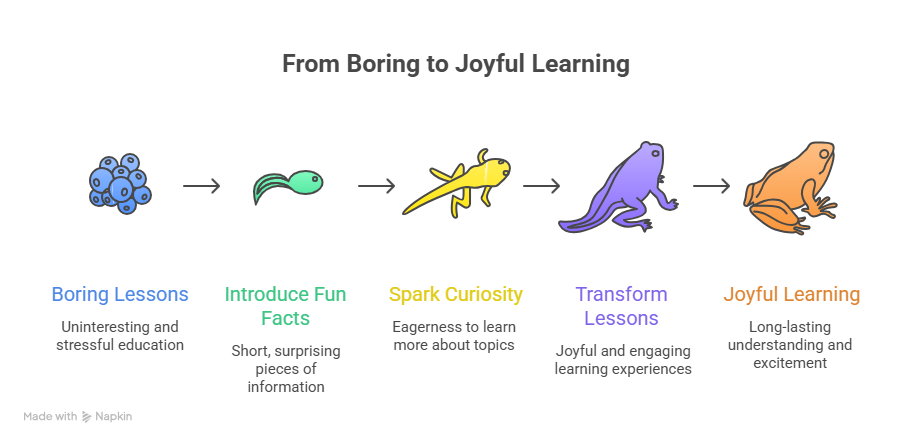
Learning in the early years should never feel boring or stressful. For children studying in Classes 1 to 5, education works best when it is filled with curiosity, excitement, and a sense of wonder. One of the simplest and most effective ways to achieve this is through fun facts. Fun facts are short, interesting pieces of information that surprise children and make them eager to learn more. They transform lessons into joyful experiences and help young learners remember concepts for a long time.
This detailed article is specially designed for teachinghub.co.in and focuses on how fun facts can support learning for students from Classes 1 to 5 across different subjects.
Why Fun Facts Are Perfect for Classes 1 to 5
Children in primary classes have active imaginations and curious minds. They enjoy learning when the information feels like a discovery rather than a task. Fun facts help in building this mindset. When children hear something unexpected, their brains become more alert, and learning happens naturally.
Fun facts help young learners by:
- Making lessons enjoyable and interactive
- Improving memory and understanding
- Encouraging curiosity and questioning
- Supporting reading and listening skills
- Reducing fear of subjects like math and science
For teachers and parents, fun facts are powerful tools to keep children engaged without pressure.
Fun Facts About Animals That Children Love 🐶🐘
Animals are one of the most loved topics for young learners. They easily capture attention and make science lessons exciting.
- An elephant is the largest land animal, but is afraid of bees.
- Dolphins sleep with one eye open.
- A giraffe’s tongue can be longer than 45 cm.
- Cats can make over 100 different sounds.
- A frog can drink water through its skin.
These animal fun facts help children learn about habitats, body parts, and animal behavior in a simple and memorable.
Fun Facts About the Human Body 🧠❤️
Children are fascinated by their own bodies. Fun facts make basic science concepts easy to understand.
- The human brain works even when you are asleep.
- Your heart starts beating before you are born.
- The nose can remember over 50,000 smells.
- Humans have five senses, but scientists say we actually have more.
- You grow faster during sleep than when you are awake.
These facts encourage children to take care of their health and apperitiate the amazing bodies .
Fun Facts About Space and the Universe 🌍🌟
Space facts create a sense of wonder and imagination among young learners.
- The Sun is a star, not a planet.
- The Moon changes its shape, but it does not actually change.
- There is no sound in space because there is no air.
- Astronauts wear special suits because space is very cold and very hot.
- One day on Venus is longer than one year on Earth.
Such fun facts inspire curiosity about science and help children think beyond Earth.
Fun Facts About Plants and Nature 🌱🌸
Nature-related facts help children connect with the environment and learn responsibility.
- Plants make their own food using sunlight.
- A banana is actually a berry.
- Trees can communicate with each other underground.
- Some flowers open only at night.
- Rainforests are home to more than half of Earth’s animals.
These facts teach children the importance of plants, trees, and protecting nature.
Fun Facts About Numbers and Math 🔢➕
Math becomes more friendly when children see its fun side.
- The number zero was discovered in India.
- A circle has no corners.
- The number 7 is the most common favorite number.
- Math helps in games, shopping, and cooking.
- Patterns are a part of math and can be found everywhere.
Such facts reduce fear of math and help children understand its importance in daily life.
Fun Facts About Countries and the World 🌏🗺️
Learning about the world builds awareness and confidence in young minds.
- There are 195 countries in the world.
- India has the largest postal network.
- The coldest place on Earth is Antarctica.
- Oceans cover more than 70% of the Earth.
- Some countries have more than one capital city.
These facts support social studies lessons and improve general knowledge.
Fun Facts About Everyday Objects ✏️🏫
Children enjoy discovering secrets about things they see every day.
- A pencil can draw a line 35 km long.
- Honey never spoils and can last for years.
- School bells were first used in factories.
- Paper was invented in China.
- A clock moves because of energy.
These facts help children observe their surroundings more carefully.
Fun Facts About Language and Communication 🗣️📖
Language learning becomes interesting when children know these facts:
- The alphabet A to Z has 26 letters in English.
- A sentence always starts with a capital letter.
- Some words sound the same but have different meanings.
- Reading improves imagination and vocabulary.
- Stories help children learn morals and values.
These facts support reading, writing, and communication skills.
How Teachers Can Use Fun Facts in the Classroom
Teachers can easily include fun facts in daily teaching:
- Start the day with a Fun Fact of the Day
- Use them during lesson introductions
- Add them to worksheets and quizzes
- Encourage students to share fun facts
- Use them as short reading activities
Fun facts keep classrooms lively and students attentive.
How Parents Can Use Fun Facts at Home
Parents can also make learning enjoyable:
- Share one fun fact during dinner
- Use fun facts while helping with homework
- Encourage children to search for fun facts
- Discuss fun facts during travel
- Turn fun facts into small quizzes
This strengthens the bond between parents and children while learning together.
Importance of Fun Facts for Online Learning Platforms
For educational platforms like teachinghub.co.in, fun facts play a vital role. They:
- Increase student engagement
- Support teachers with ready content
- Improve reading interest
- Make digital learning enjoyable
- Help children learn independently
Fun facts are short, effective, and perfect for young learners in digital formats.
Conclusion
Fun facts are more than just interesting information. For students in Classes 1 to 5, they are a bridge between curiosity and learning. They make education joyful, meaningful, and stress-free. Whether used in classrooms, at home, or on educational platforms like teachinghub.co.in, fun facts help children explore the world with excitement and confidence. When children enjoy learning, they do not just remember facts—they develop a lifelong love for knowledge.