
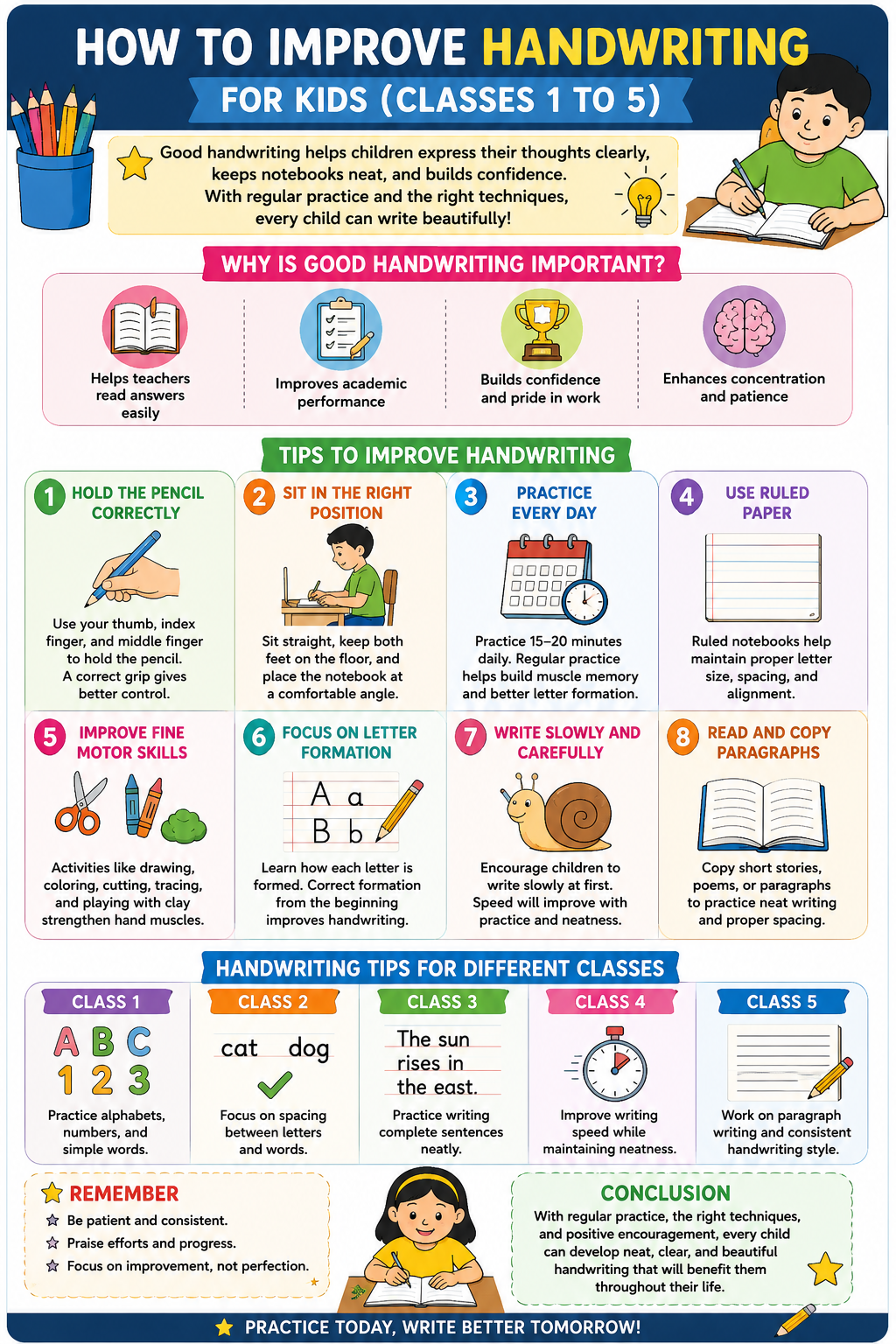
Handwriting is an important skill that helps children express their thoughts clearly and complete schoolwork neatly. Good handwriting makes notebooks look organized, helps teachers read answers easily, and boosts a child’s confidence. Although some children naturally write neatly, others need regular practice and guidance to improve their handwriting.
Why Is Good Handwriting Important?
Good handwriting helps children perform better in school. When writing is clear and easy to read, teachers can understand answers without difficulty. Neat handwriting also encourages children to take pride in their work and develop better concentration and patience.
Tips to Improve Handwriting
1. Hold the Pencil Correctly
Children should learn the proper way to hold a pencil using their thumb, index finger, and middle finger. A correct grip gives better control and makes writing easier.
2. Sit in the Right Position
Good posture is important while writing. Children should sit straight, keep both feet on the floor, and place the notebook at a comfortable angle. This helps them write smoothly without getting tired.
3. Practice Every Day
Daily practice is the key to improving handwriting. Even 15–20 minutes of writing alphabets, words, and sentences can make a big difference. Consistent practice helps children develop muscle memory and better letter formation.
4. Use Ruled Paper
Ruled notebooks help children maintain proper letter size, spacing, and alignment. Younger students can use four-line notebooks to practice forming letters correctly.
5. Improve Fine Motor Skills
Activities such as drawing, coloring, tracing, cutting paper, and playing with clay strengthen hand muscles. Strong hand muscles help children control their pencils better and write more neatly.
6. Focus on Letter Formation
Children should learn how each letter is formed. Writing letters correctly from the beginning prevents bad habits and improves overall handwriting quality.
7. Write Slowly and Carefully
Many children try to write quickly and make mistakes. Encourage them to write slowly at first. Speed will naturally improve with practice while maintaining neatness.
8. Read and Copy Short Paragraphs
Copywriting exercises are excellent for improving handwriting. Children can copy short stories, poems, or paragraphs from books to practice neat writing and proper spacing.
Handwriting Tips for Different Classes
- Class 1: Practice alphabets, numbers, and simple words.
- Class 2: Focus on spacing between letters and words.
- Class 3: Practice writing complete sentences neatly.
- Class 4: Improve writing speed while maintaining neatness.
- Class 5: Work on paragraph writing and consistent handwriting style.
Conclusion
Improving handwriting takes time, patience, and regular practice. Parents and teachers should encourage children and praise their efforts instead of focusing only on mistakes. With proper guidance, daily practice, and positive motivation, every child can develop neat, clear, and beautiful handwriting. Good handwriting is a valuable skill that will benefit students throughout their academic journey and beyond.