
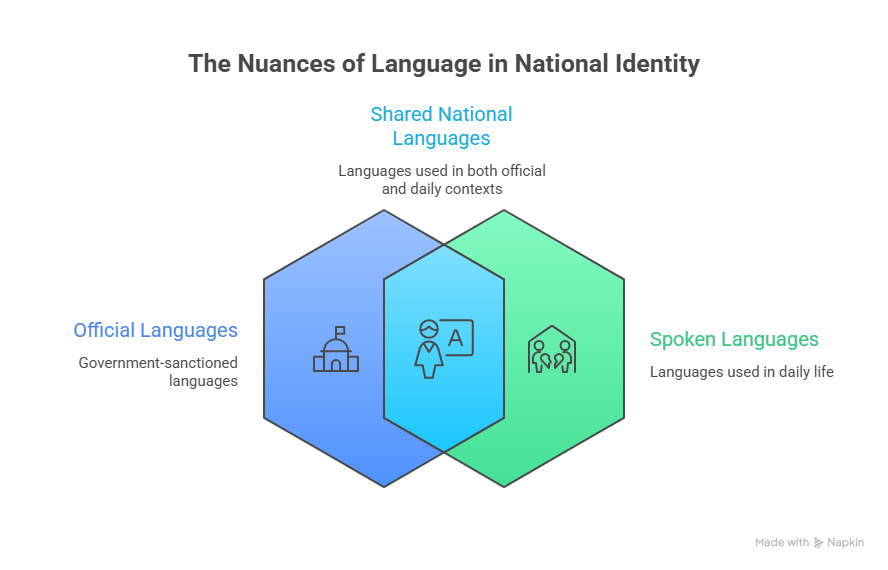
Language is one of the most powerful markers of human identity. It carries history, culture, values, and ways of thinking, and it shapes how communities communicate with one another and with the world. Across the globe, people speak thousands of languages, and no two countries share the same linguistic situation. Some nations are largely monolingual, while others are home to hundreds of languages spoken side by side. Understanding what languages people speak in different countries requires looking at history, geography, migration, and politics, as well as the difference between official languages and the languages people actually use in daily life.
Official Languages vs. Spoken Languages
Many countries designate one or more official languages, which are used in government, education, and legal systems. However, the languages people speak at home or in their communities may be very different. For example, a country may have a single official language but dozens of regional or minority languages. In other cases, countries recognize multiple official languages to reflect their diverse populations.
In addition, some languages function as lingua francas—common languages used for communication among people who do not share a native tongue. English, French, Spanish, Arabic, and Swahili are examples of languages that play this role in different parts of the world.
Languages in Europe
Europe is linguistically diverse, despite its relatively small size. Many European countries are associated with a dominant national language. For instance, French is primarily spoken in France, Italian in Italy, Polish in Poland, and Greek in Greece. These languages are deeply tied to national identity and are used in education, government, and media.
However, multilingualism is common. Switzerland has four official languages: German, French, Italian, and Romansh. Belgium recognizes Dutch (Flemish), French, and German, reflecting its complex political and cultural structure. Spain has Spanish (Castilian) as its official national language, but regional languages such as Catalan, Basque, and Galician are widely spoken and officially recognized in their regions.
English is spoken as a native language in the United Kingdom and Ireland, but it is also widely spoken as a second language across Europe, especially in countries like the Netherlands, Sweden, and Denmark, where English proficiency is very high.
Languages in the Americas
The languages of the Americas are strongly shaped by colonization. Spanish is the dominant language in most of Latin America, including Mexico, Colombia, Argentina, and Peru. Portuguese is spoken in Brazil, the largest country in the region. French is used in parts of the Caribbean, such as Haiti and Martinique, and in Canada.
In North America, English is the primary language in the United States and Canada, while French is also an official language in Canada, particularly in the province of Quebec. Spanish is widely spoken in the United States due to historical ties and immigration, making it one of the most commonly used languages in the country.
Indigenous languages remain an important part of the linguistic landscape, though many are endangered. Languages such as Quechua, Guarani, Nahuatl, and Maya are still spoken by millions in South and Central America, often alongside Spanish or Portuguese.
Languages in Africa
Africa is the most linguistically diverse continent in the world, with over 2,000 languages spoken. Many African countries have one or more European languages as official languages due to colonial history. For example, English is an official language in Nigeria, Kenya, and South Africa; French is used in Senegal, the Ivory Coast, and the Democratic Republic of the Congo; and Portuguese is spoken in Angola and Mozambique.
At the same time, indigenous African languages are widely used in everyday life. Swahili serves as a major lingua franca in East Africa, spoken in countries such as Tanzania, Kenya, and Uganda. Hausa, Yoruba, and Igbo are widely spoken in Nigeria, while Amharic is the primary language of Ethiopia.
South Africa is a notable example of linguistic recognition, with 11 official languages, including Zulu, Xhosa, Afrikaans, and English. This reflects the country’s commitment to cultural and linguistic diversity.
Languages in Asia
Asia is home to some of the world’s most widely spoken languages. Mandarin Chinese is the most spoken native language globally and is the official language of China and Taiwan. China itself is linguistically diverse, with many regional languages such as Cantonese, Shanghainese, and Hokkien, though they are often referred to as dialects.
In South Asia, Hindi and English are widely used in India, but the country officially recognizes 22 languages, including Bengali, Tamil, Telugu, Marathi, and Urdu. India is a clear example of how multilingualism functions on a national scale. Pakistan uses Urdu and English officially, while Punjabi, Pashto, Sindhi, and Balochi are commonly spoken.
In East Asia, Japanese is spoken in Japan, and Korean is spoken in North and South Korea. Southeast Asia features languages such as Thai in Thailand, Vietnamese in Vietnam, and Indonesian in Indonesia. Indonesia alone has over 700 languages, with Bahasa Indonesia serving as a unifying national language.
Languages in the Middle East
The Middle East is closely associated with Arabic, which is spoken in many countries, including Saudi Arabia, Egypt, Iraq, and Jordan. However, Arabic exists in wide regional varieties, and people often speak both a local dialect and Modern Standard Arabic, which is used in formal contexts.
Other important languages in the region include Persian (Farsi) in Iran, Turkish in Turkey, and Hebrew in Israel. Kurdish is spoken by millions across Turkey, Iraq, Iran, and Syria, though it does not have official status in all these countries.
Languages in Oceania
In Australia and New Zealand, English is the dominant language. However, indigenous languages such as those of Aboriginal Australians and the Māori language in New Zealand are culturally significant and increasingly supported through education and media.
The Pacific Islands are linguistically rich. Countries like Papua New Guinea have hundreds of languages. English, French, and local Creole languages are often used alongside indigenous languages to facilitate communication between different communities.
Global Trends and Multilingualism
Globalization, migration, and technology are reshaping how languages are used worldwide. Many people grow up bilingual or multilingual, switching between languages depending on context. Large cities, in particular, are linguistic melting pots where dozens or even hundreds of languages may be spoken.
English has become the dominant global lingua franca, used widely in international business, science, and on the internet. However, other languages such as Spanish, Chinese, Arabic, and French also play significant international roles.
Conclusion
The languages people speak in different countries reflect complex histories and living cultures. While some nations are defined by a single dominant language, many others thrive on linguistic diversity. Official languages provide structure and unity, but local and indigenous languages preserve identity and heritage. Understanding the world’s languages helps us appreciate cultural differences and encourages mutual respect in an increasingly interconnected world. Language is not just a tool for communication—it is a living record of humanity itself.